
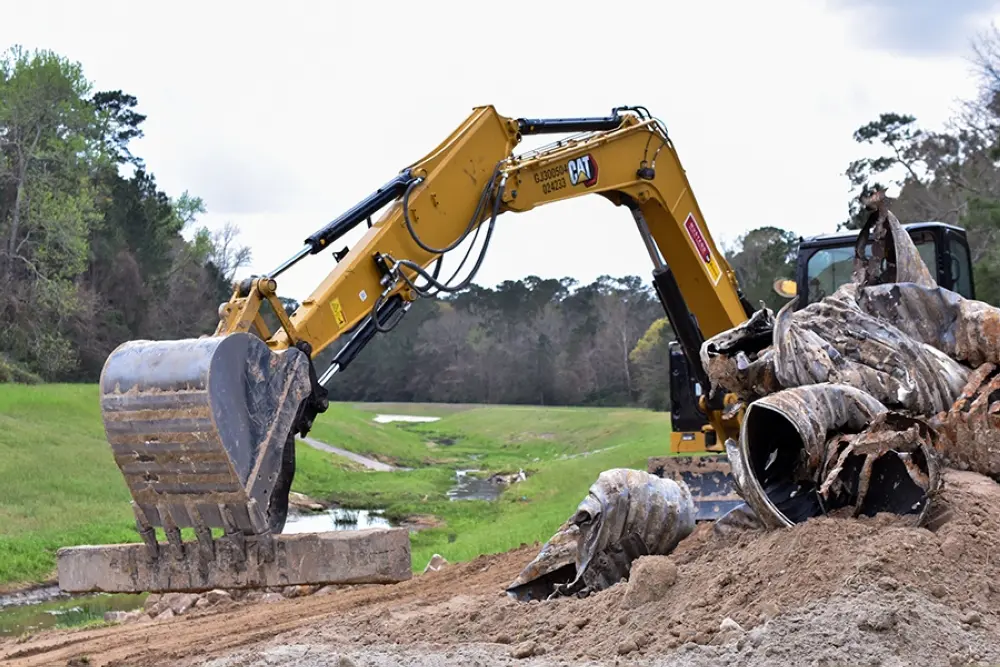
Among other projects at The Woodlands Water Agency, he township’s 35 miles of drainage ditches are undergoing $3 million in improvements that will take 12-18 months to complete. (Vanessa Holt/Community Impact)
Source: Community Impact
Water infrastructure in The Woodlands is seeing long-term renewal and replacement projects under consideration this year after a process of community feedback and professional studies has led governing agencies to narrow down the scope of some projects.
While some projects are underway now, such as a $3 million project to clear drainage ditches and improve stormwater flow, others will require further study to determine a path forward, such as a multimillion-dollar plan to replace or refurbish the township’s oldest wastewater facility on Sawdust Road.
Officials said they are looking to steer away from using bonds to finance large projects, so residents could potentially see higher water bills as the projects move forward in the coming years.
Two-minute impact
More than 50 years after The Woodlands’ founding in 1974, plans to upgrade or replace parts of the community’s water infrastructure are underway, but officials said recent findings have led them to consider eliminating or delaying several projects, while others could be phased in over several years.
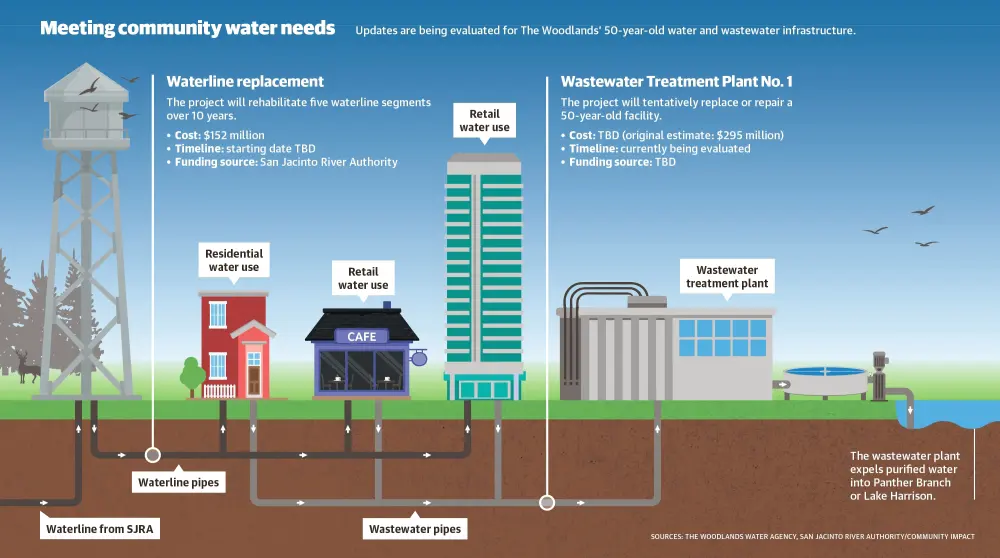
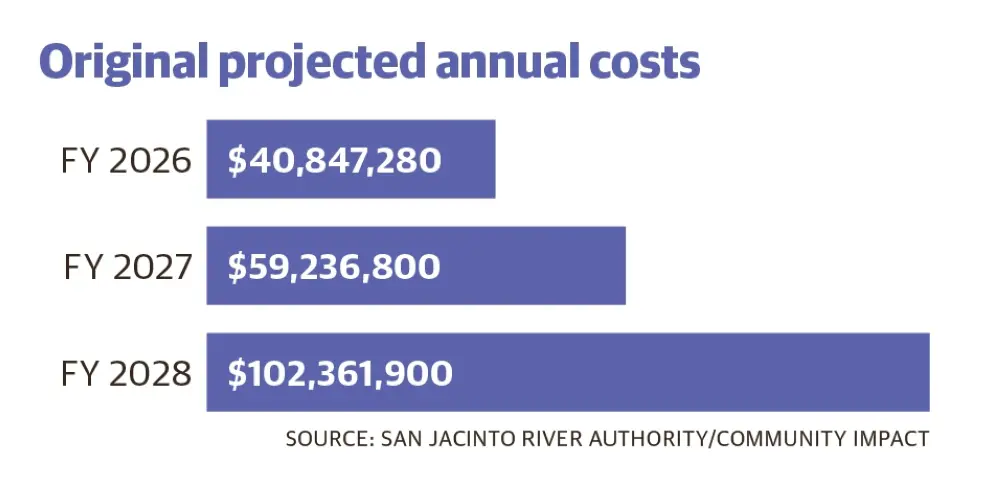
An initial projection of $729 million for the San Jacinto River Authority’s 10-year 2026-35 project plan for The Woodlands division is being revised downward after receiving community input and several studies, said Erich Peterson, general manager of The Woodlands Water Agency. The agency oversees the 10 Montgomery County municipal utility districts in The Woodlands.
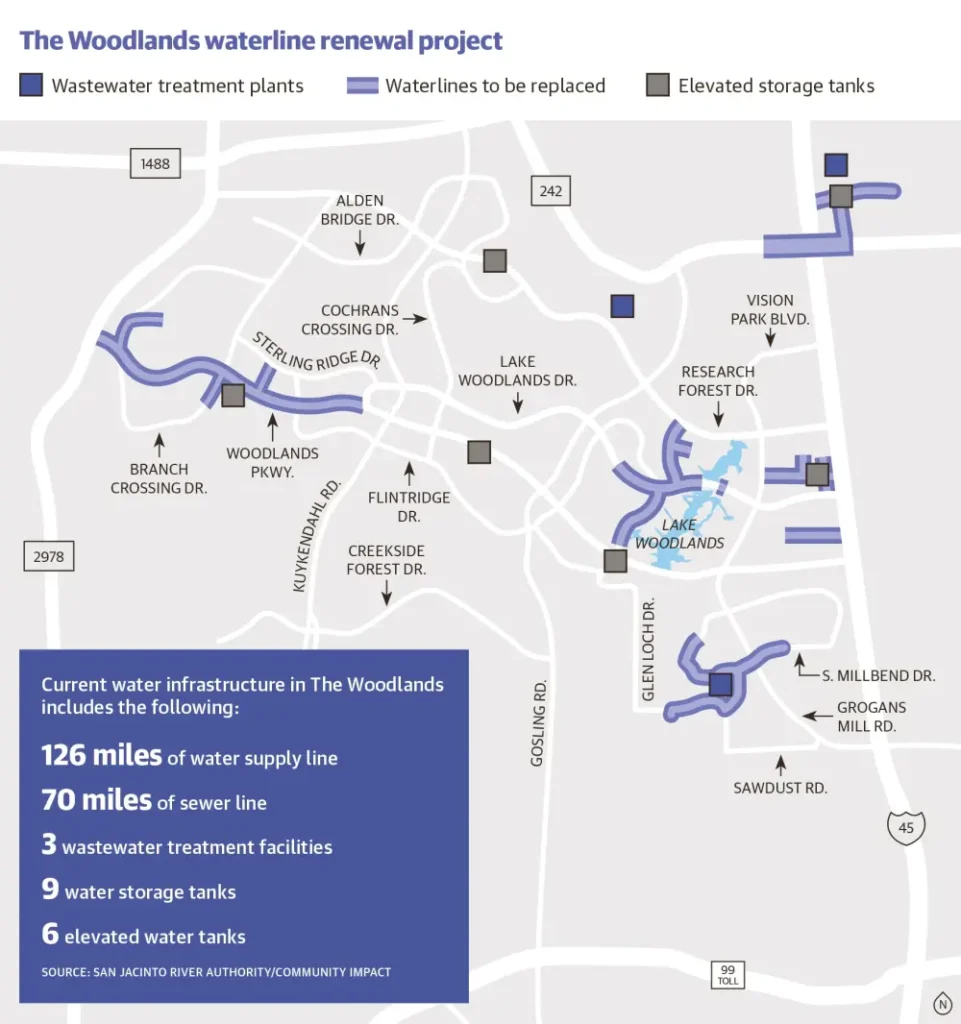
A year-long waterline condition assessment concluded in late 2025, and the results show that original estimates for $250 million in needs could be reduced to about $150 million for asbestos cement waterline replacement in the next 10 years, he said. In addition, a $100 million project to convert lift stations near Sawdust Road to gravity lines was deemed not cost-effective and will not be pursued.
However, the wastewater treatment plant on Sawdust Road in the Village of Grogan’s Mill is still being evaluated to determine whether a replacement is needed, as a full replacement could cost “hundreds of millions” of dollars, he said.
“Age in itself is not the only criteria that you should be looking at,” Peterson said. “And so the MUDs are focused on wanting to look at the condition as well.”
Meanwhile, a $13 million sanitary sewer project to rehab gravity mains near the south shore of Lake Woodlands is wrapping up this spring. Additionally, a new $3 million drainage ditch project is aimed at improving water flow to prevent flooding, which is the third focus of the township’s water agency.
What residents should know
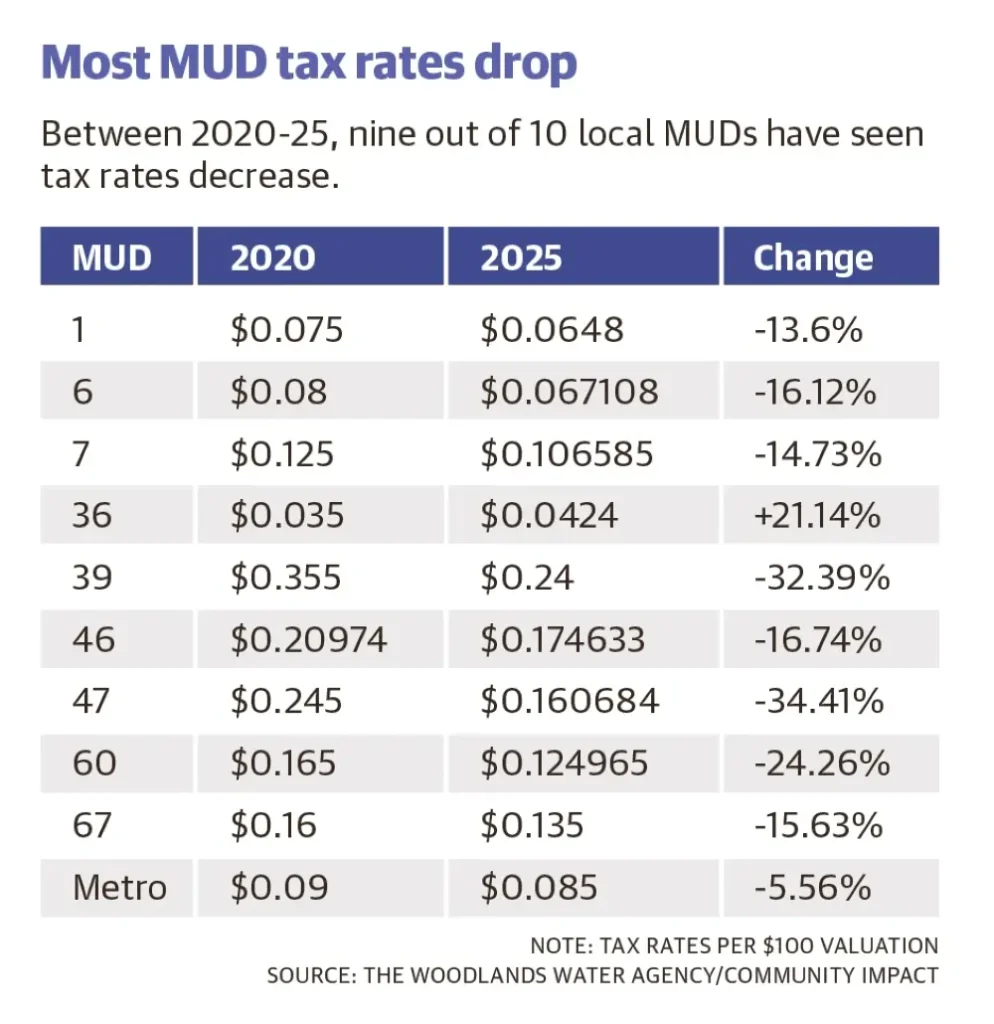
Peterson said the agency has no immediate plans to hold a bond election to support infrastructure needs, but users could see increases to their water rates in the future, as a MUD cannot raise its tax rate by more than 3.5% each year without voter approval.
“The Woodlands taxes are some of the lowest tax rates in Montgomery County,” Peterson said. “That sounds good, but when you have big ticket items and recent legislation limits what MUDs can do in terms of raising their rates.”
Another detail
The township’s 35 miles of drainage ditches are also undergoing $3 million in improvements that will take 12-18 months to complete, Peterson said.
“We did a first-of-its-kind, 10-month evaluation of every ditch in The Woodlands,” Peterson said. “Overall, The Woodlands ditches are in great shape, but we have some things to address.”
Drainage needs have also increased with the community’s age, said Laura Norton, vice president of MUD 47.
“While it has been a long time, we do sometimes have … incredible rain events,” Norton said. “We do use our streets to hold some water, but we need to get it out of the neighborhoods.”
The work being carried out this year will continue as part of routine maintenance, Peterson said.
“We have built a proactive maintenance program that we have not had in the past,” he said.
Who it affects
Water service and traffic could see impacts from rehabilitation projects, Peterson said.
The current South Shore sanitary sewer project, which includes repairing manholes, requires frequent single-lane closures to protect workers. However, other forthcoming projects will have a larger impact, he said.
“When we get into the waterline rehabilitation projects, that is going to be a little more impact,” he said.
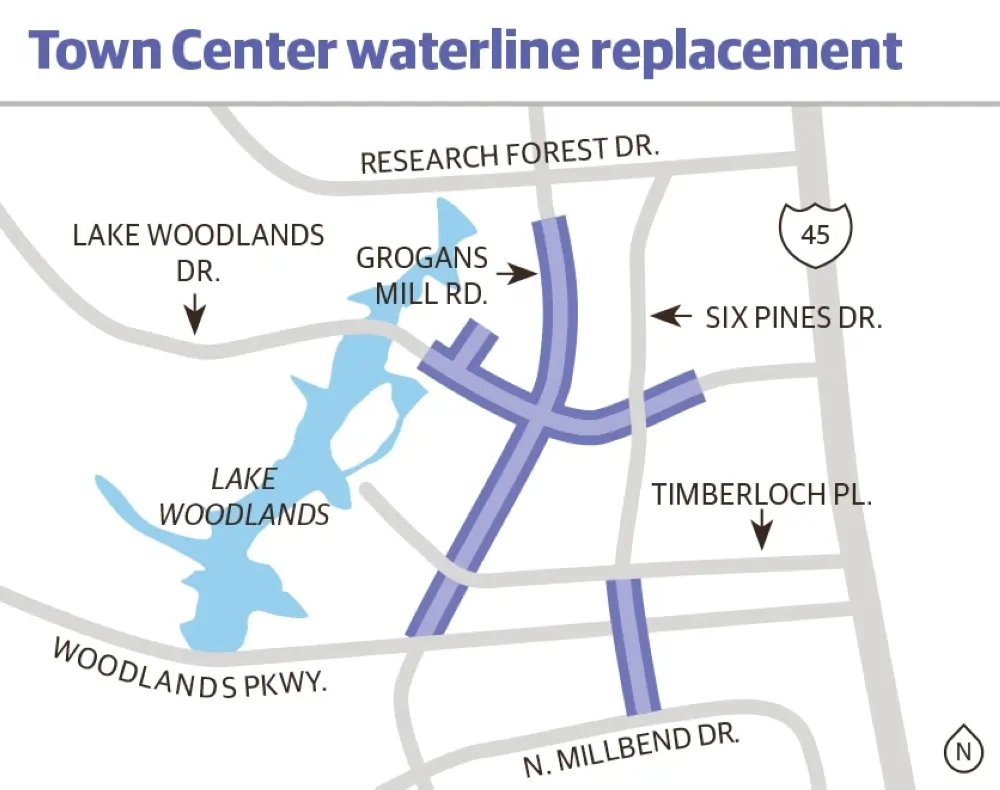
This includes a $24.2 million project potentially starting by the end of 2027 to rehabilitate lines in Town Center. Peterson said that will include single-lane closures over a longer period of time in the Grogan’s Mill area. Design work is underway on that project.
Service interruptions will be limited to when the lines are tied in to service at each end.
“Every effort will be looked at to minimize interruption,” Peterson said.
Public input
As part of its efforts to gather feedback, Woodlands Water formed the Community Working Group last year, consisting of MUD representatives, residents and stakeholders.
Feedback, along with results from the waterline assessment study, has led Woodlands Water to reconsider several previous recommendations for the SJRA’s revised 10-year project plan this spring.
The SJRA and MUDs will re-evaluate some waterlines not addressed immediately for work in years 12-15, Peterson said. Initially projected costs will likely come down as a result of this and other reductions, he said.
Next steps
Discussions about what projects will move forward will fall to future MUD board members.
Norton said an influx of retirees from the oil and gas industries has joined the MUD boards in recent years, bringing expertise in overlapping areas. It has also made the elections, which take place in May, more competitive, she said.
“The current MUD directors are very much focused on a business mindset to solve our problems,” said John Thaeler, a MUD 67 director and retired geologist.
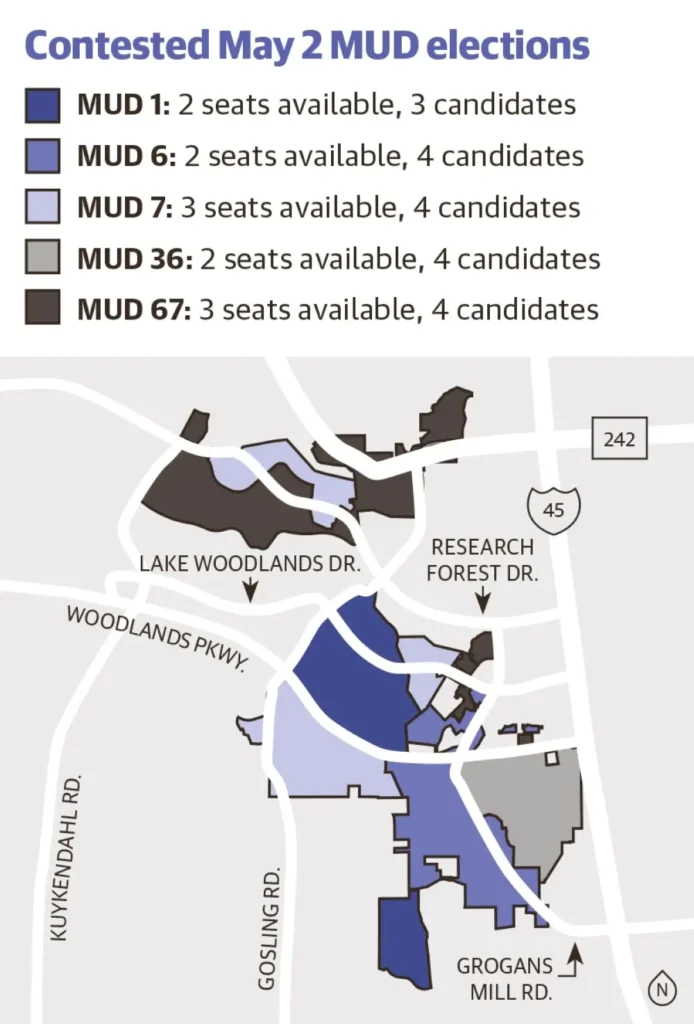
In May, five of the nonpartisan MUD boards will see contested elections in The Woodlands.
Norton said MUD directors also increasingly live within their districts, which is not strictly required by Texas law.
“It’s important MUD directors are residents and drink the water,” Norton said.